

Harry Winston Sunflower Diamond Necklace – A Collateral Loan Case Study Example
For almost 100 years, Harry Winston has been a leading name in rare and exceptional jewellery. The Sunflower necklace is one of the most established and recognisable collections within the house, and can be a source of significant capital for a loan from a luxury pawnbroker.
The diamonds’ inherent qualities, the condition of the eye-catching flowerhead settings, and the integrity of the articulated links are the core areas that determine the secondary market value of these distinctive pieces.
This illustrative case study explains how these physical details, when paired with supporting documents and auction evidence, dictate the possibilities when a customer wants to use a Harry Winston Sunflower diamond necklace as collateral for a loan.


Scenario: An auction payment before another artwork is sold
In this illustrative scenario, a private collector buys a drawing at auction and needs £15,000 to complete payment within the settlement period. A second artwork is already consigned to a sale in three months’ time, but its proceeds would not arrive before the payment deadline.
The collector does not want to sell a Harry Winston Sunflower necklace received as a family gift. Instead, they consider a five-month loan, with the intention of repaying from the consigned artwork’s net proceeds after commission and sale charges.
For this example, the necklace is assumed to measure approximately 38.5 cm and contain around 20.25 carats of diamonds. The owner retains its maker’s case and a purchase invoice and declares no repairs or alterations.
We would request photographs of the complete necklace, individual flowerheads, reverse, links, clasp, marks and available documents, so that we could make an initial indication.
Identifying the Sunflower diamond necklace
The customer sends photos of the necklace. It features a graduated series of brilliant-cut diamond flowerheads separated by pairs of similarly cut diamonds. To the eye, it seems like over 20 carats of diamonds. The chain is 38.5 cm; it contains a Winston signature, the HW maker’s mark, a French assay mark and a maker’s case.[
Those details provide a starting point, but require more research. Our specialist would establish its construction, dimensions, metal, stone arrangement and identifying marks, then check whether the supporting records correspond with the physical piece.
Establishing the necklace as a Sunflower is not enough to establish value. Variations in the size of the central diamond and the total number and identity of the gems can all dramatically affect secondary market price and even the potential buyer pool.
Why the flowerheads and diamond matching matter
The appraisal would consider how the diamonds work together across the graduated design. Differences in colour, clarity, cut or apparent brightness would need to be recorded, particularly if one stone appears inconsistent with those surrounding it.
The specialist would examine the flowerheads for chipped diamonds, damaged settings and evidence of replacement stones. A repaired necklace could remain an authentic Harry Winston piece, but authenticity and retention of its original components are separate questions.
The connecting links would also require attention. Wear, distortion or previous repairs could affect how the necklace moves and sits, while a shortened or altered necklace would need to be distinguished from an example retaining its original configuration.
Condition, supporting documents and repair history
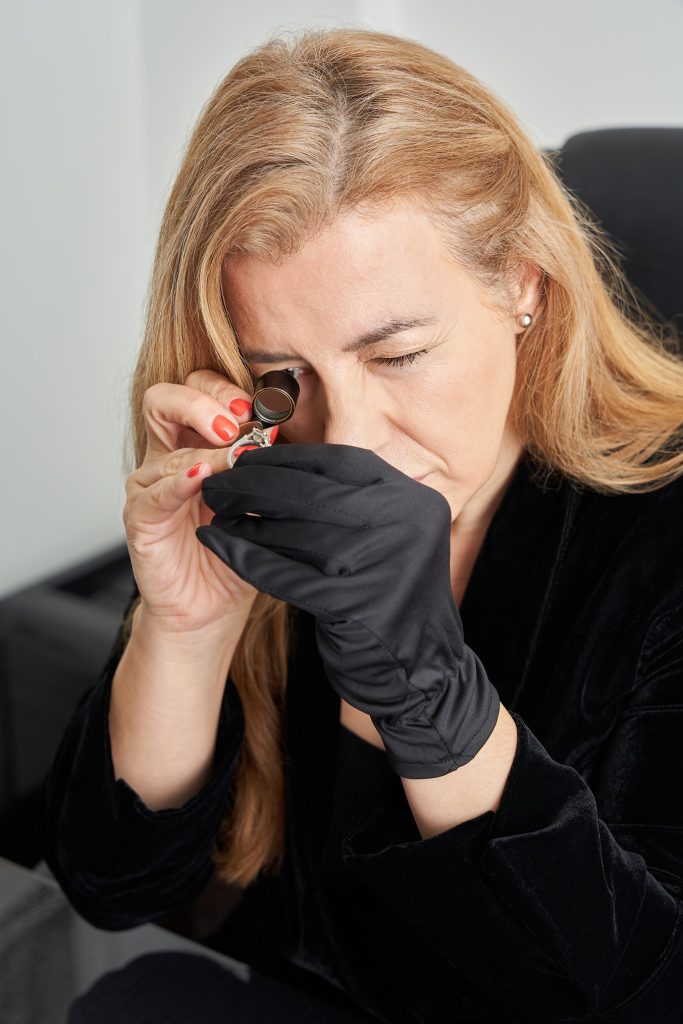
Our specialist would examine the necklace’s front and reverse, checking the settings, connecting links and clasp for wear or damage. Particular attention would be paid to stone security, signs of soldering, altered components and the operation of the fastening.
The Winston signature, maker’s mark and assay marks would be reviewed alongside the necklace’s construction. Marks would support identification but would not establish authenticity of this fine jewellery by themselves.
The purchase invoice could help connect the necklace with its stated model and ownership history. However, it would not confirm the present condition or prove that every diamond and component remains original. Finally, the maker’s case would be recorded as part of the accompanying materials.
Researching comparable Harry Winston Sunflower necklace prices
Our research would focus on full Sunflower necklaces with a similar graduated flowerhead design, total diamond weight, length and condition. Smaller pendants and substantially different necklace configurations would not provide direct price comparisons.
Bonhams sold a Sunflower necklace with approximately 20.25 carats of diamonds for £35,000, including buyer’s premium, in November 2018. The necklace measured 38.5 cm, was signed Winston, carried the HW maker’s mark and a French assay mark, and came with its maker’s case. This provides a documented completed-sale benchmark for a closely specified example.
The specialist would compare the owner’s necklace with that lot, considering diamond quality, setting condition, repairs, configuration and accompanying materials. The age of the result would also matter because it does not establish what a similar necklace would achieve today.
For the numerical illustration below, £30,000 is used as a provisional assessment assumption.
Specialist assessment in Mayfair
The owner brings the necklace, maker’s case and purchase invoice to our Mayfair premises.
Using magnification and appropriate gemmological equipment, our specialist would examine the diamonds for damage and assess their apparent quality and consistency. Mounted settings can limit the precision of grading and weight estimates, so any findings would need to reflect those limitations. Further testing or specialist examination could be required where identification or treatment questions remain unresolved.
The necklace’s overall dimensions, graduation and stone arrangement would be checked against its stated description. The settings, articulated links, clasp and marks would then be reviewed for wear, alteration and repair.
These findings would be considered alongside the purchase documentation and market evidence. The specialist would not presume successful authentication, satisfactory condition or a favourable valuation.
Illustrative collateral-loan assessment
If inspection and updated market research support an assessment of £30,000, an illustrative lending proportion of 60% would produce a potential advance of £18,000.
Both figures are scenario assumptions. The percentage is not a confirmed offer or fixed lending policy, and the £30,000 assessment is not established by the Bonhams result alone.
An £18,000 potential advance would exceed the owner’s £15,000 funding requirement. At the same assumed lending proportion, an assessment of £25,000 would produce £15,000.
The amount available could fall if the necklace has chipped or replaced diamonds, worn settings, damaged links, alterations, unresolved identification concerns or weaker current market support than anticipated. Any such findings would need to be reflected in the assessment rather than overlooked because the necklace carries the Harry Winston name.
A five-month agreement, secure storage and redemption
If a suitable offer is available and the owner wishes to proceed, they would provide the required photo identification, proof of address and supporting documents. We would supply the relevant pre-contract information and proposed loan agreement in plain and easy-to-understand language.
The intended period allows for the three-month wait until the consigned artwork’s auction, followed by time for payment and settlement. Before proceeding, the owner would need to review the total amount repayable and consider how repayment would be managed if the artwork sells for less than expected or settlement is delayed.
If an agreement is completed, the necklace and agreed accompanying items would be held as security in secure storage. Repayment in accordance with the agreement would allow the owner to redeem and collect them.
Could your Harry Winston necklace support a specialist assessment?
A Sunflower necklace assessment would bring together its precise configuration, diamond quality and matching, setting and link condition, identifying marks, repair history and supporting records. A published auction result can inform the comparison, but the individual necklace and current evidence remain central to any potential offer.
Owners can contact New Bond Street Pawnbrokers for an initial indication and arrange a specialist assessment at 5 Blenheim Street, Mayfair.
Any loan is subject to assessment, acceptance and the terms of the agreement. An initial indication or valuation does not guarantee that a loan will be offered.
Featured in the Press
Our quality service, high standards, and innovative business practices have earned positive press coverage from a diverse set of media outlets such as The Times, The Telegraph, Time Out, Channel 4, The Spectator, and more.