


Rolex Submariner – A Collateral Loan Case Study Example when using watches as security
Our Rolex Submariner Date 16610 Case Study Example Scenario explains how we may value this classic modern timepiece for a short-term collateral loan, while also looking at the factors that can influence value, the importance of up-to-date secondary market information, and what a potential client could expect on their pawnbroking journey.


Introduction to the client
In this illustrative scenario, a business owner contacts New Bond Street Pawnbrokers to explore a short-term loan against his luxury watch. He owns a Rolex and wants to understand whether its secondary-market value could provide sufficient collateral without having to sell the watch permanently.
He contacts us by telephone for an initial loan estimate. At this stage, the purpose is not to assign a final value remotely, but to establish which Submariner he owns, what supporting material is available and whether the watch appears suitable for a more detailed assessment.
While not essential, these initial discussions can give our clients a rough figure to work with because photographs and model names can support an initial indication. However, we can only confirm a final watch-loan offer after physical authentication and condition review at our Mayfair premises.
First contact and qualifying questions
During an initial call, we would ask which Rolex model the owner has and whether it is accompanied by its original box and papers. These details can help identify the watch, establish its history and determine how complete the set is. Warranty documents, purchase receipts, service records and spare bracelet links may also provide useful supporting information, although the watch itself remains central to our valuation.
An initial Rolex enquiry should identify the precise reference wherever possible. The Submariner first appeared in the 1950s, and the current generation is still being produced today. Depending on the finer details and reference, secondary market prices can be anywhere between £6,000 and £11,000. In this scenario, the client states he owns a Submariner Date reference 16610.
Based on the information, a Submariner Date reference 16610 of this type could potentially support a loan in the region of £5,000. Of course, this figure would be subject to physical inspection, authentication, supporting documentation and the market evidence available at that time.
Establishing the precise reference
In this scenario, the watch is identified as a Rolex Submariner Date reference 16610. However, since production of the 16610 began in 1988 and ended in 2010, there have been five different marks with slightly different dial variants. Though subtle, these differences can matter when it comes to valuation.
For example, the early tritium, drilled-lug watch typically attracts a premium when original and attractively aged due to its interesting configuration and strong collector appeal. The illustrative client’s model had a laser-etched coronet, which means we would place it in the 2003 to 2010 era, when 16610s moved to solid lug cases with no visible lug holes.
Completeness also contributes to the assessment. A correctly matched warranty paper or card, original box, service records, tags and spare links can improve provenance and confidence. However, paperwork does not authenticate a watch by itself; conversely, its absence does not make every older Submariner unsuitable. The watch, its components and the available documents must be considered together.
Researching comparable Submariner auction prices
Auction results can show what buyers have paid for comparable watches, but only when the examples are interpreted properly. An auction estimate is a pre-sale guide, while a sold price records the outcome of a particular transaction. A dealer’s online asking price is different again because it may include servicing, warranty, margin and room for negotiation.
A useful comparable should therefore match the subject watch as closely as possible by reference, production period, dial, bezel, bracelet, condition, originality and set completeness. Outliers can still be informative, but they must be identified as exceptional rather than folded into a misleading average.
While contemporary auction prices for the 16610 have settled at between £7-8,000, during the luxury-watch market peak of 2021-2022, average prices for these beloved timepieces were as high as £10,500. In theory, a client may have bought at the top of the market; however, any collateral loan would be based on today’s market prices.
Inspecting the watch in Mayfair
In this scenario, the customer brings his Submariner 16610 to our Mayfair office for the physical assessment. He explains that he requires the loan to support short-term business cash flow after an expected invoice payment was delayed by 21 days. As he anticipates receiving the payment shortly, he expects to need the loan for no more than two months.
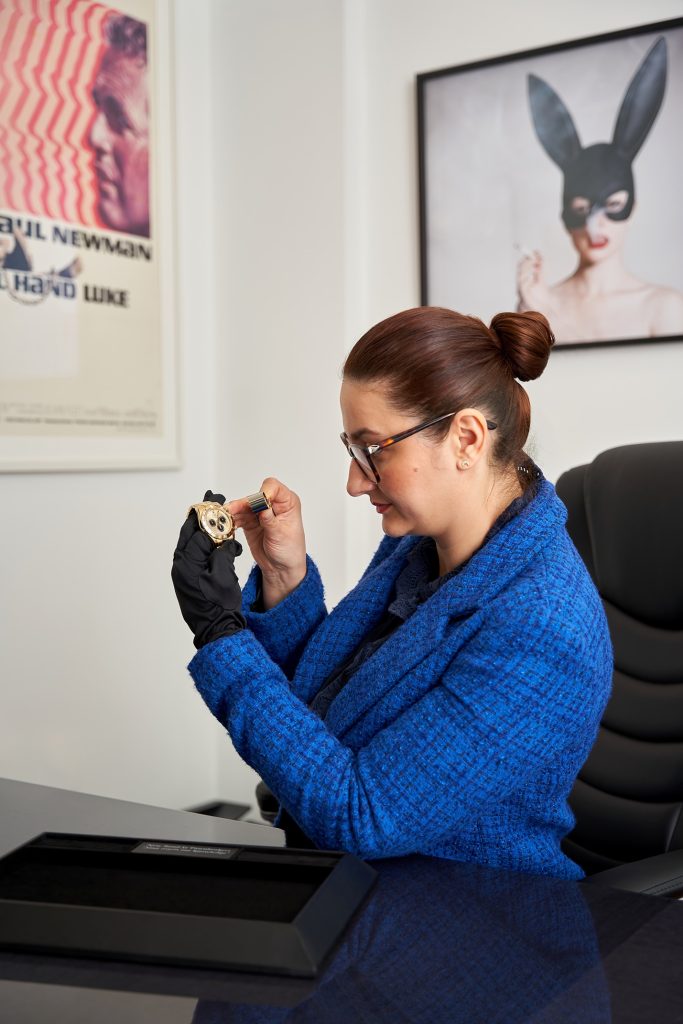
Our in-house Rolex specialist inspects the Submariner 16610 using gloves, a watch tray and a loupe. The reference and serial details, case, dial, hands, bezel, sapphire crystal, crown, bracelet and clasp are checked for consistency with the watch’s production period and configuration.
The appraisal considers dial printing and colour, date magnification, the laser-etched coronet where appropriate, and signs of wear, damage, over-polishing or replaced components. The bracelet and clasp would then be tested for smooth, secure operation, while the bracelet could be removed to inspect relevant markings.
We would then review boxes, papers, service records, invoices and spare links alongside the watch itself. Once authentication and condition checks were complete, we would compare findings with current auction and secondary-market evidence for similar 16610 examples.
Illustrative loan assessment: a £5,000 example
A watch’s secondary-market value and its collateral-loan value are not the same figure. The market valuation considers what the exact watch might realistically achieve in a sale, while a potential loan offer must also account for the time, costs and uncertainty involved if the asset ultimately has to be sold.
Our loan offers are commonly in the region of 50% to 70% of realistic secondary-market value, depending on the asset and its suitability as collateral. This is not an automatic formula: condition, originality, documentation, liquidity and current demand can all affect the amount that may be available.
In this illustrative example, if the Submariner 16610 passed authentication, was in suitable condition and compared favourably with current market evidence, an offer in the region of £5,000 would not be unrealistic. This is not a guaranteed valuation or loan amount. Another reference 16610 could support a higher or lower figure depending on its exact specification, condition, completeness and market position when examined.
Reviewing the agreement and receiving the funds
If an indicative offer was acceptable and the customer wished to proceed, they would be asked to provide the required identification and supporting documentation. In this example, that would include a valid driving licence or passport, together with proof of address dated within the previous three months.
We would then provide the pre-contract information and loan agreement, allowing the customer to review the amount borrowed, applicable charges, loan term and redemption arrangements before making a decision. No agreement would be completed unless all relevant parties were satisfied with the terms.
If a loan agreement were completed, the Rolex Submariner would serve as security and be placed into secure storage for the agreed period. On repayment in accordance with the terms of the agreement, the customer would be able to redeem and collect the watch.
Other reasons owners use a Submariner as collateral
While business cash flow was the loan purpose in this case study example, owners may consider borrowing against a Rolex Submariner for other short-term funding needs. Common use cases across the luxury-asset lending sector include:
- Financing stock or equipment
- Managing a tax deadline
- Bridging a property transaction
- Paying education costs
- Meeting an unexpected professional or household expense
A collateral loan may appeal to somebody who wants to access part of a watch’s value without agreeing to a permanent sale. Suitability still depends on the owner’s circumstances, the amount required, the cost of borrowing and a realistic repayment plan. The sentimental or collector value of the watch should also form part of that decision.
Could your Rolex support a similar loan?
This illustrative example shows how a Rolex Submariner enquiry could progress from an initial telephone discussion to an in-person valuation and, where appropriate, a potential loan offer. It also demonstrates why two outwardly similar Submariners may produce different outcomes: reference, production details, originality, condition, documents and current market evidence all matter.
Owners considering using a Rolex Submariner as collateral can contact New Bond Street Pawnbrokers for an initial indication and arrange a specialist assessment at 5 Blenheim Street, Mayfair. Any final offer will be based on the individual watch and the market evidence available when it is examined.
Any loan is subject to assessment, acceptance, and the terms of the agreement; a valuation or initial indication does not guarantee that a loan will be offered.
Other case studies: Fine watches
Case study: pawning a A. Lange & Söhne Lange 1 101.021
A retired architect needs £10,000 towards urgent roof repairs while a notice savings account takes eight weeks to release funds. They consider a three-month loan against a yellow-gold A. Lange & Söhne Lange 1 reference 101.021 bought to mark their…
Case study: pawning a Vacheron Constantin Overseas 4500V/110A-B128
A consultant needs £12,000 to meet an overseas postgraduate tuition deadline for their daughter, six weeks before a scheduled investment withdrawal. They consider a two-month loan against a steel Vacheron Constantin Overseas 4500V/110A-B128 rather than a permanent sale. This illustrative…
Case study: Omega Speedmaster Professional 145.022-69
A self-employed consultant has a personal tax payment due before a fixed-term deposit is released, and needs about £2,500 for two months. Rather than sell a long-held Speedmaster Professional 145.022-69, they ask whether it could secure a short-term loan. This…
Case study: pawning a Chopard L.U.C 1860
A parent needs around £5,000 to meet a school-fee deadline that falls before a scheduled investment distribution, and considers a white-gold Chopard L.U.C 1860 reference 16/1860/2 as collateral rather than selling a watch with sentimental value. This illustrative case study…
Case study: pawning an IWC Big Pilot’s Watch IWC500901
A homeowner faces an urgent roof-repair bill of around £2,500 before a fixed-term savings account becomes accessible, and considers a short-term loan against an IWC Big Pilot’s Watch IW500901 rather than selling it. This illustrative case study walks through the…
Case study: pawning a F.P. Journe Chronomètre Bleu
A collector plans to bid on a painting, but the auction’s payment deadline falls before a fixed-term deposit matures. He explores whether his F.P. Journe Chronomètre Bleu could bridge the gap without selling a watch he intends to pass on…
Case study: pawning a Richard Mille RM 11-03
An entrepreneur has agreed terms to buy a small specialist business and needs a deposit within a short window, before proceeds from the sale of another interest arrive later in the quarter. He would rather borrow against his grade 5…
Case study: pawning a Breguet Type XX Aéronavale
A self-employed contractor has a confirmed project settlement on the way but needs to cover staff costs and materials before it clears. Rather than sell a Breguet Type XX Aéronavale 3800ST worn for many years, he explores a short-term loan.…
Case study: pawning a Cartier Tank Cintrée CPCP
Ahead of a close family wedding, a client needs to meet supplier payments before the proceeds of a property sale arrive, and wants temporary funding against a yellow-gold, hand-wound Cartier Tank Cintrée from the Collection Privée Cartier Paris rather than…
Case study: pawning an Audemars Piguet Royal Oak 15500ST
A creative-industry professional is waiting on a delayed final payment for a completed project and would rather borrow against a Royal Oak Selfwinding 15500ST than sell a watch bought to mark a career milestone. This illustrative case study explains why…
Case study: Pawning a Patek Philippe Nautilus
A company director needs to bridge a time-sensitive property commitment without selling the stainless-steel Patek Philippe Nautilus 5711/1A he has owned for several years. This illustrative case study follows the enquiry from first conversation to inspection at our Mayfair office,…
Featured in the Press
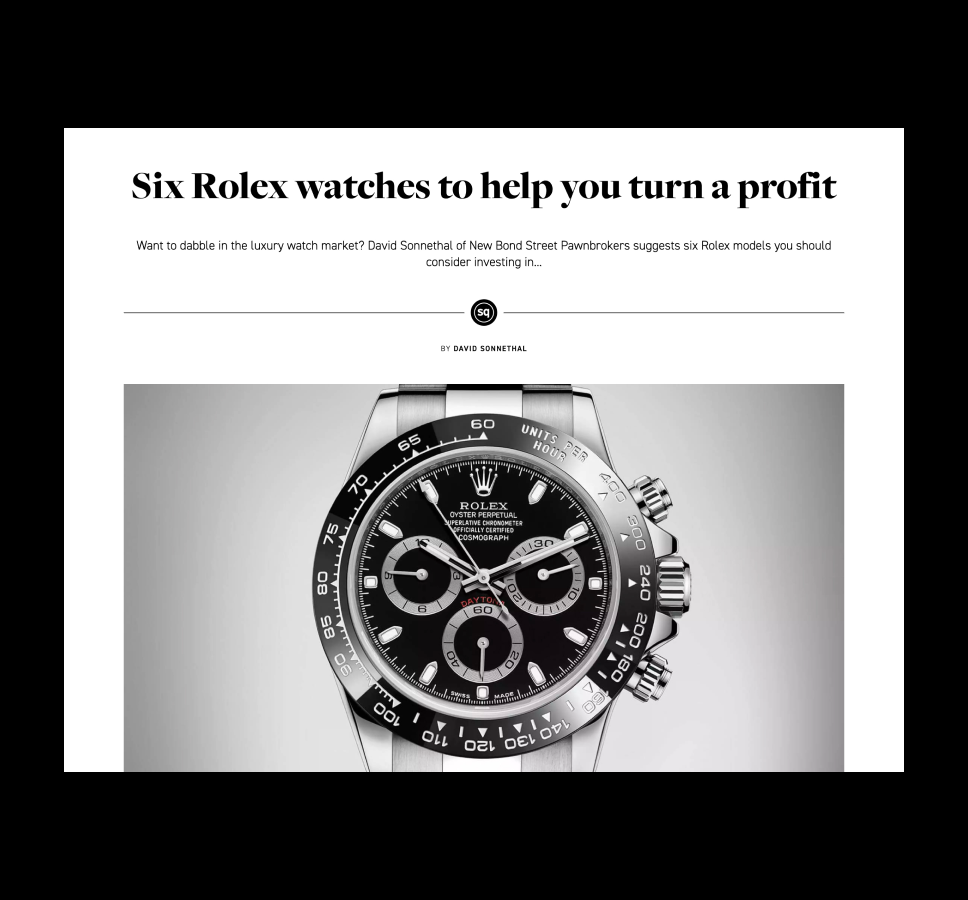
Our quality service, high standards, and innovative business practices have earned positive press coverage from a diverse set of media outlets such as The Times, The Telegraph, Time Out, Channel 4, The Spectator, and more.