


Bulgari Monete Tubogas Necklace – A Collateral Loan Case Study Example
A Bulgari Monete Tubogas necklace brings together two of the House’s heritage icons: Monete, its ancient-coin jewellery collection, and Tubogas, its signature goldsmithing technique. An ancient coin sits at the centre of a flexible, rounded collar handcrafted without soldering. The combination creates a sculptural jewel that contrasts the coin’s aged surface with the smooth contours of the gold collar.
In the luxury pawnbroking industry, not every asset comes through the door in perfect condition. This illustrative example features a slightly dented ancient coin and explores how this scenario might affect appraisal and the final loan offer when someone wants to use a Bulgari Monete Tubogas Necklace as collateral for a loan.


Scenario: Laundry equipment before a busy trading period
In this illustrative scenario, the owner of a small hotel needs £15,000 towards replacing its commercial laundry equipment before a busy trading period. They can fund the balance of the purchase from business reserves but want to avoid using all the available working capital.
The owner considers a six-month loan against a personally owned Bulgari Monete Tubogas necklace. They intend to repay from the hotel’s net operating income over the following months rather than sell a family-held piece.
The owner retains a purchase invoice and Bulgari presentation case. They declare a small dent towards one side of the collar, with no repair attempted. The necklace appears to retain its usual shape, but without an in-person inspection, we could not confidently forecast how it might perform on the secondary market.
The customer enquires by email and sends detailed photos of the necklace.
Identifying the Monete Tubogas necklace
Bulgari’s Monete jewellery is a reflection of its Roman identity. Since the 1960s, the House has used coin jewels in its work, with many incorporating inspirations identifying rulers, dates, and coin types.
The Tubogas element is also drenched in Bulgari history. It takes its name from the flexible metal pipes used to carry gas, with the jewellery having similar rounded, flexible construction.
For this scenario, the necklace is a Monete Tubogas necklace, circa 1994. It features an ancient coin held in a rub-over mount on a collar of sprung design. This attribution would be the starting point for our appraisal, alongside factors like collar dimension, fastening, and identifying marks.
Why the coin and its mounting require specialist knowledge
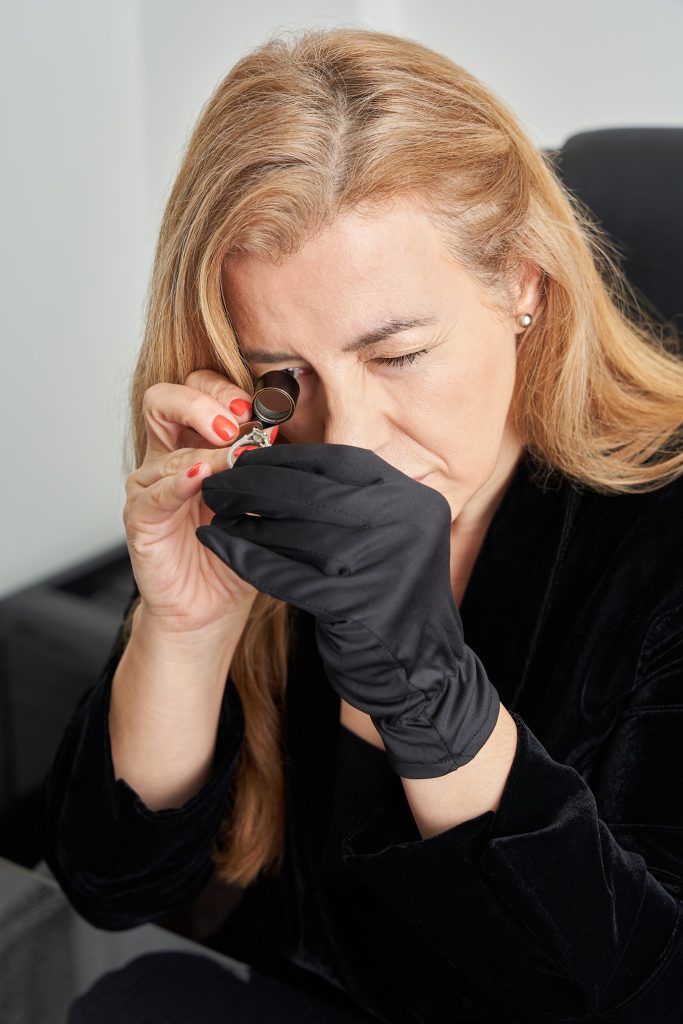
Our specialist would look at the coin and the necklace separately at first. Visible portraits, inscriptions and reverse designs would be considered alongside any wording engraved on the mount and then compared with available documentation.
The setting also affects what can be examined. A rub-over mount surrounds the coin’s edge, so assessment of the mounted coin may be more restricted than inspection of a loose example.
Bulgari states that its Monete mounts follow the coins’ contours while leaving their structure unaltered. The appraisal would therefore consider whether the mounting and visible coin appear coherent with that approach, and whether any later work is evident.
Tubogas condition, the dent and supporting records
As mentioned earlier, the customer declared a dent in the collar. Our specialist would inspect the damaged area and adjacent coils for distortion, uneven spacing and signs of previous intervention. They would consider whether the dent appears localised or is associated with a change in the collar’s shape or movement.
The owner’s report that the necklace still sits normally would be useful background, but it is something we would need to check for ourselves. The core reason here is so we can understand how it might affect the buyer pool or estimate repair possibility and cost.
The coin mounting, collar ends and fastening would be examined separately. Bulgari signatures and relevant metal or maker’s marks would be reviewed alongside workmanship and documents.
Researching comparable Bulgari Monete necklace prices
In July 2026, a Monete Tubogas necklace, circa 1994, sold for £35,840 at Bonhams. The illustrated model is remarkably similar. One interesting note about the Bonhams example is that the sale exceeded its £15,000–£20,000 estimate.
Before assuming that £35,840 is a typically achievable market price, our specialist would compare the auction lot’s coin, mounting, collar dimensions, materials, condition and accompanying items with the owner’s necklace. All things being equal, that price may prove instructive. However, our hypothetical asset has a declared dent, which cannot be ignored.
The £35,840 result includes buyer’s premium. It is not the hammer price, the seller’s net proceeds or the amount the necklace could support as a loan. For the numerical illustration below, £30,000 is used as a provisional secondary-market assessment assumption.
Specialist assessment in Mayfair
The owner brings the necklace, purchase invoice and presentation case to our Mayfair premises.
The specialist would examine the visible coin details, mount, collar construction, fastening and marks, documenting the dent and any associated distortion. The collar would be handled with appropriate care.
The assessment would bring together three distinct questions, namely:
- Is the necklace consistent with the stated Bulgari configuration,
- Is the coin identification adequately supported?
- Does the collar’s condition permit further lending consideration?
If the damage requires technical examination beyond the preliminary appraisal, that would need to be addressed before an offer.
Illustrative collateral-loan assessment
If physical inspection and comparable evidence support a secondary-market assessment of £30,000, an illustrative loan-to-value ratio of 50% would produce a potential advance of £15,000.
That would meet the hotel owner’s stated contribution towards the laundry equipment. Business reserves would cover the balance.
The assessment would already need to reflect the collar’s condition. The 50% proportion represents additional caution in this scenario if the necklace is acceptable for lending, but uncertainty remains around its future saleability or the implications of the documented damage.
It is not a fixed Bulgari lending policy, nor an automatic percentage for every dented piece. A reduced advance would not substitute for resolving a structural or identification concern.
Reviewing a six-month loan against trading income
The proposed £15,000 loan would need to fit the hotel’s equipment budget and projected cash flow. Six months is the owner’s preferred borrowing period, although the term offered would depend on the available agreement.
To proceed, the owner would supply the necessary identification, proof of address and supporting records. They would receive pre-contract information explaining the advance, interest, charges, settlement date and how to redeem the necklace.
Once an agreement is completed, the necklace and accepted accompanying items would be documented and placed in secure storage. The condition record would include the declared dent. Repayment under the agreed terms would allow the owner to arrange their return.
Discussing a Bulgari Monete necklace as collateral
A Monete Tubogas assessment depends on the relationship between the ancient coin, its mounting and the flexible collar. Coin identification, Bulgari workmanship, condition and closely matched auction evidence all contribute to the lending decision.
New Bond Street Pawnbrokers can review the available photographs and records before arranging a physical appraisal at 5 Blenheim Street, Mayfair. An initial discussion may identify what further information or examination is needed; it does not establish a final advance.
Lending remains subject to assessment, acceptance and the agreement’s terms. Neither an auction comparison nor a provisional valuation guarantees an offer.
Featured in the Press
Our quality service, high standards, and innovative business practices have earned positive press coverage from a diverse set of media outlets such as The Times, The Telegraph, Time Out, Channel 4, The Spectator, and more.