


Audemars Piguet Royal Oak 15500ST – A Collateral Loan Case Study Example when using watches as security
What happens when a client wants to use an Audemars Piguet watch as collateral for loans? This example considers the reference-specific factors that may affect an assessment, including its dial, finishing, bracelet, documentation and current market position when you want to use an Audemars Piguet Royal Oak watch as collateral for loans.


Scenario: Funding a project payment gap
In this illustrative scenario, a creative-industry professional contacts New Bond Street Pawnbrokers while awaiting the final payment for a completed commercial project. The payment had been agreed but was due later than expected, and the owner wants to explore a short-term loan rather than selling a Royal Oak bought to mark a career milestone.
They supply photographs of the watch, box, warranty documentation, invoice and service paperwork. These images help us identify the likely reference and understand the apparent condition. While these details are adequate for an initial assessment, any final decision always hinges on physical inspection at our premises in Mayfair.
Identifying the correct Royal Oak
In this example, the watch is identified as a Royal Oak Selfwinding 15500ST, a 41 mm stainless-steel model with a sapphire display back, screw-locked crown and Audemars Piguet’s automatic Calibre 4302. The movement has central seconds, a date display and an approximately 70-hour power reserve.
These details matter because the 15500ST should not be grouped automatically with the 15400ST it replaced, the later 15510ST, a Royal Oak Chronograph, Offshore or precious-metal Royal Oak. These watches have a lot of similarities in design, but their references, specifications, production period and buyer demand differ.
The client’s watch has a dark-blue Grande Tapisserie dial. We would check its grid-like guilloché pattern, applied hour markers and Royal Oak hands alongside the reference and case details. Correct configuration is one part of the assessment of the timepiece; condition is the next.
Why Royal Oak finishing matters
The Royal Oak’s appearance is defined by the relationship between satin-brushed surfaces and polished bevels. These finishing transitions run across the octagonal bezel, case and bracelet, giving the Royal Oak a distinctive look. However, wear or over-polishing can impact that definition.
Our Audemars Piguet specialists would consider the bezel edges, screw-head condition, case flanks, crystal, crown and the definition of the original finishing. Wear is not automatically a problem, but softened bevels, uneven brushing, pronounced dents or careless refinishing can affect how a watch is viewed in the secondary market.
The integrated bracelet is also central to the appraisal. We would examine its links, clasp, articulation and overall condition, as missing links, damage or excessive wear can affect fit, desirability and potential saleability. The Royal Oak bracelet is a big part of the overall design. As such, it’s an important part of valuing the asset.
Documents, service and movement
Our hypothetical owner retains the original box, warranty card, purchase invoice and service paperwork. This supporting material can increase confidence in the watch’s history, but it must correspond with the watch. What’s more, from a luxury pawnbroking perspective, it never replaces physical authentication.
The 15500ST’s display back allows the Calibre 4302 to be viewed. Where appropriate, the movement and rotor can provide further evidence of the watch’s configuration and condition. Service documentation was also useful, although service work needs to be understood carefully. For example, it can show that a watch has been maintained, but may also reveal replacing components or refinishing that can limit potential buyers.
Audemars Piguet offers an Extract from the Archives for qualifying watches. Again, while this is always welcomed by us, its purpose is to confirm the appearance of case and movement numbers in its records rather than guaranteeing authenticity.
Comparing relevant market evidence
The market for Royal Oak watches contains many different models and references. From a collateral loan perspective, a steel 15500ST should be compared with similar 15500ST examples, and not a smaller Royal Oak, a gold model, a chronograph, an Offshore or a limited edition.
A correct, attractive steel 15500ST can commonly sit in the broad region of £28,000 to £40,000 in the current secondary market. The exact position depends on dial colour, finishing, bracelet condition, service history, box and papers and the market evidence available at the time. Current pre-owned market tracking places the model at approximately £31,000, although private-sale figures can be lower and dealer listings higher.
An advertised dealer price, an auction result and an online listing should not be treated as interchangeable. The best comparables are recent completed transactions involving watches with the closest possible match in reference, dial, condition and completeness.
A physical assessment in Mayfair
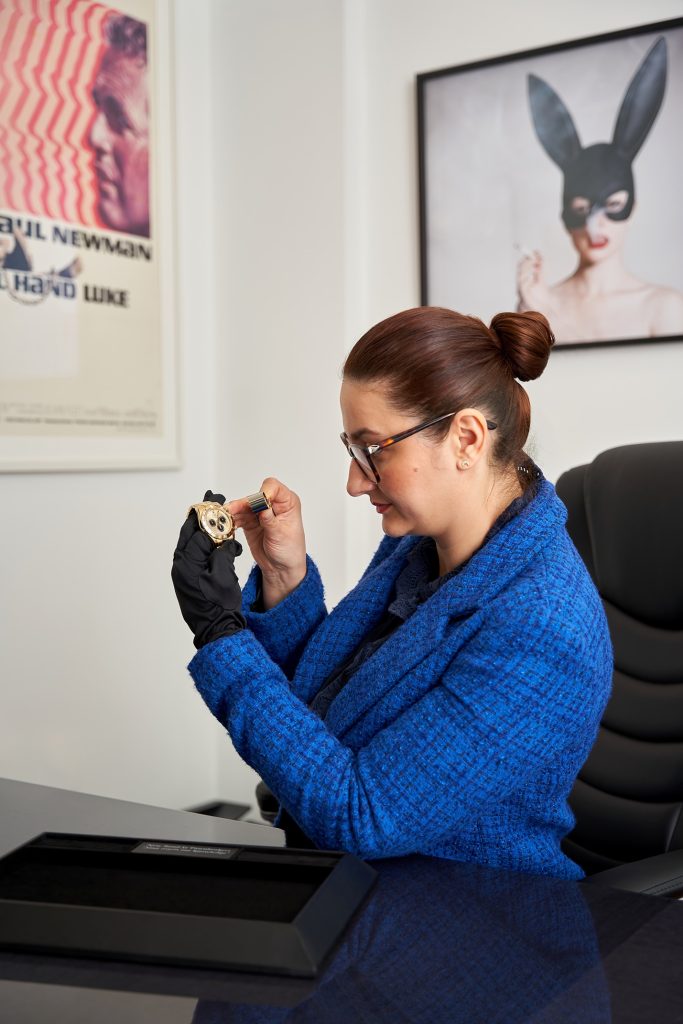
The owner brings the Royal Oak to 5 Blenheim Street, Mayfair, for inspection. Using magnification and appropriate handling equipment, our specialist reviews the case, dial, hands, bezel, crown, crystal, bracelet, clasp and visible movement. From there, they consider the supplied documents alongside the watch.
The final appraisal brings together three core areas:
- The watch’s reference and apparent component consistency
- Its preservation, service record and completeness
- Current evidence for comparable 15500ST examples.
This is why we consider a photograph-led estimate as only a starting point. While reference can often be identified remotely, the details most likely to influence a final outcome, such as finishing quality and bracelet condition, need to be assessed in person.
Illustrative loan assessment
A secondary-market price is not the same as the amount a watch may support as collateral. A potential loan reflects the individual asset, authentication outcome, condition, liquidity, current demand and the time and costs involved if resale were ever necessary.
In this illustrative example, the blue-dial 15500ST retains its original bracelet and is accompanied by its warranty documentation, box and supporting paperwork. If it passes authentication and compares favourably with contemporary evidence, a short-term loan in the region of £18,000 to £24,000 could be possible.
Of course, it’s important to understand that range is illustrative only. A heavily polished watch, missing warranty documentation, bracelet issues, or replaced components could lead to a higher or lower assessment. Additionally, ebbs and flows in the Royal Oak market will also determine loan values at any particular time.
From agreement to redemption
If the owner wishes to proceed, they would be asked to provide the relevant identification and proof of address. We would then issue pre-contract information and the loan agreement, setting out the amount, loan term, applicable charges and redemption arrangements.
In this example, the owner needs to borrow to bridge their finances over a short term. They select a two-month loan of £22,000 at a fixed interest rate of 5%. In this case, monthly interest is £1,100 per month, meaning a total repayment of £24,200 at the end of the loan term.
Once an agreement was completed, the Royal Oak would be held as security in secure storage for the agreed period. When the client receives the delayed project payment, they could repay the loan in accordance with the terms and arrange to redeem their watch.
Could your Audemars Piguet support a loan?
This example shows why a Royal Oak is valued as an individual watch, rather than simply as an Audemars Piguet. The exact reference, dial, quality of the case and bracelet finishing, movement, documents, service record and current market evidence can all affect the assessment.
Contact New Bond Street Pawnbrokers for an initial indication and arrange a specialist assessment at 5 Blenheim Street, Mayfair. Any loan is subject to assessment, acceptance and the terms of the agreement.
Other case studies: Fine watches
Case study: pawning a A. Lange & Söhne Lange 1 101.021
A retired architect needs £10,000 towards urgent roof repairs while a notice savings account takes eight weeks to release funds. They consider a three-month loan against a yellow-gold A. Lange & Söhne Lange 1 reference 101.021 bought to mark their…
Case study: pawning a Vacheron Constantin Overseas 4500V/110A-B128
A consultant needs £12,000 to meet an overseas postgraduate tuition deadline for their daughter, six weeks before a scheduled investment withdrawal. They consider a two-month loan against a steel Vacheron Constantin Overseas 4500V/110A-B128 rather than a permanent sale. This illustrative…
Case study: Omega Speedmaster Professional 145.022-69
A self-employed consultant has a personal tax payment due before a fixed-term deposit is released, and needs about £2,500 for two months. Rather than sell a long-held Speedmaster Professional 145.022-69, they ask whether it could secure a short-term loan. This…
Case study: pawning a Chopard L.U.C 1860
A parent needs around £5,000 to meet a school-fee deadline that falls before a scheduled investment distribution, and considers a white-gold Chopard L.U.C 1860 reference 16/1860/2 as collateral rather than selling a watch with sentimental value. This illustrative case study…
Case study: pawning a Rolex Submariner
A business owner whose invoice payment has been delayed by three weeks contacts us by telephone to see whether his Rolex Submariner Date 16610 could support a short-term loan without a permanent sale. This illustrative case study covers the qualifying…
Case study: pawning an IWC Big Pilot’s Watch IWC500901
A homeowner faces an urgent roof-repair bill of around £2,500 before a fixed-term savings account becomes accessible, and considers a short-term loan against an IWC Big Pilot’s Watch IW500901 rather than selling it. This illustrative case study walks through the…
Case study: pawning a F.P. Journe Chronomètre Bleu
A collector plans to bid on a painting, but the auction’s payment deadline falls before a fixed-term deposit matures. He explores whether his F.P. Journe Chronomètre Bleu could bridge the gap without selling a watch he intends to pass on…
Case study: pawning a Richard Mille RM 11-03
An entrepreneur has agreed terms to buy a small specialist business and needs a deposit within a short window, before proceeds from the sale of another interest arrive later in the quarter. He would rather borrow against his grade 5…
Case study: pawning a Breguet Type XX Aéronavale
A self-employed contractor has a confirmed project settlement on the way but needs to cover staff costs and materials before it clears. Rather than sell a Breguet Type XX Aéronavale 3800ST worn for many years, he explores a short-term loan.…
Case study: pawning a Cartier Tank Cintrée CPCP
Ahead of a close family wedding, a client needs to meet supplier payments before the proceeds of a property sale arrive, and wants temporary funding against a yellow-gold, hand-wound Cartier Tank Cintrée from the Collection Privée Cartier Paris rather than…
Case study: Pawning a Patek Philippe Nautilus
A company director needs to bridge a time-sensitive property commitment without selling the stainless-steel Patek Philippe Nautilus 5711/1A he has owned for several years. This illustrative case study follows the enquiry from first conversation to inspection at our Mayfair office,…

Featured in the Press
Our quality service, high standards, and innovative business practices have earned positive press coverage from a diverse set of media outlets such as The Times, The Telegraph, Time Out, Channel 4, The Spectator, and more.