


Graff Ruby and Diamond Rosette Ring – A Collateral Loan Case Study Example when using jewellery as security
Appraising a Graff ring requires a combination of specialist skills. In this illustrative example, the ring combines both ruby and diamond, meaning an appraiser must have some gemology knowledge. However, the specialist would also need familiarity with the Graff catalogue itself to identify the precise Rosette configuration and assess how its rubies and diamonds work together.
This hypothetical case study follows an owner considering a three-month loan against a ruby-and-diamond Rosette ring. It describes how we would evaluate the condition of the ring and consider supporting documents, asset history, and current secondary market prices to determine a price when a customer wants to use a Graff Ruby and Diamond Rosette as collateral for a loan.


Scenario: Replacing a failed heating system before savings mature
In this illustrative scenario, a homeowner needs £2,800 towards replacing a failed heating system. They can cover the remainder from accessible savings, but a separate savings bond does not mature for another ten weeks.
The owner considers a three-month loan against a Graff ring received as a significant anniversary gift. They intend to repay from the bond’s net maturity proceeds rather than sell the ring.
The owner retains its purchase documentation and presentation case. They describe light wear and declare no repairs, resizing or replacement stones. We request photos by email to make an initial assessment.
Identifying the ruby-and-diamond Rosette ring
Laurence Graff established the company in London in 1960. The House’s account of his early work describes his development of diamond cluster rings, followed by designs incorporating emeralds, rubies and sapphires. Some awareness of this history is important to appraising this piece.
Our specialist would record its metal, dimensions, ring size, stone arrangement and identifying marks. The purchase documentation would then be checked against those physical details. While identifying this as a Graff Rosette is a start, there are many different configurations that use this name.
The specialist would review any documented ruby and diamond weights alongside the physical ring. Where weights can only be estimated with the stones in their settings, those figures would be identified as approximate.
Why the ruby-and-diamond arrangement requires expertise
Assessing a ruby is similar to assessing a diamond. Colour, clarity, cut and size contribute to quality, while treatment can materially affect value. However, colour is the biggest factor when it comes to valuation.
For a Rosette ring, the specialist would also assess the stones together. The specialist would compare the rubies’ apparent colour, brightness, and proportions across the design alongside the diamonds’ matching and condition.
While a ruby that appeared different from its neighbour wouldn’t automatically be a sign that it has been replaced, we would need to investigate further. If origin or treatment information is necessary to support the valuation, suitable laboratory examination could be required.
Settings, condition and supporting documents
The central setting, surrounding stone seats, decorative framework and shank would be examined. Our expert would look out for wear, distortion and signs of intervention on this piece of fine jewellery. They would particularly focus on stone security and any potential damage near exposed gemstone edges.
The ring would also be measured. Its size and shape would be checked against the owner’s account, while the underside and shank would be reviewed for possible resizing or repair.
Graff signatures, numbering and relevant metal marks would be considered alongside the workmanship and purchase documentation. A clear signature would support identification, but would not be enough on its own to presume authenticity.
Researching comparable Graff Rosette ring prices
Bonhams records a ruby-and-diamond Rosette ring selling for £4,080 in February 2021. A separate Bonhams lot under the same model description records a sale of £5,737.50, also including premium. These are completed-sale results featuring a buyer’s premium.
To find the right comparable, our specialist would examine the full lot details. Relevant points would include metal, dimensions, stone arrangement, gemstone weights where documented, ring size, condition and accompanying materials.
For this numerical illustration, £4,000 is used as a provisional secondary-market assessment assumption. This estimate factors in current market evidence for Graff and accounts for the auction’s buyer premium, which is typically 20–28% of the hammer price.
Specialist assessment in Mayfair
The owner brings the ring, purchase documentation and case to our Mayfair premises.
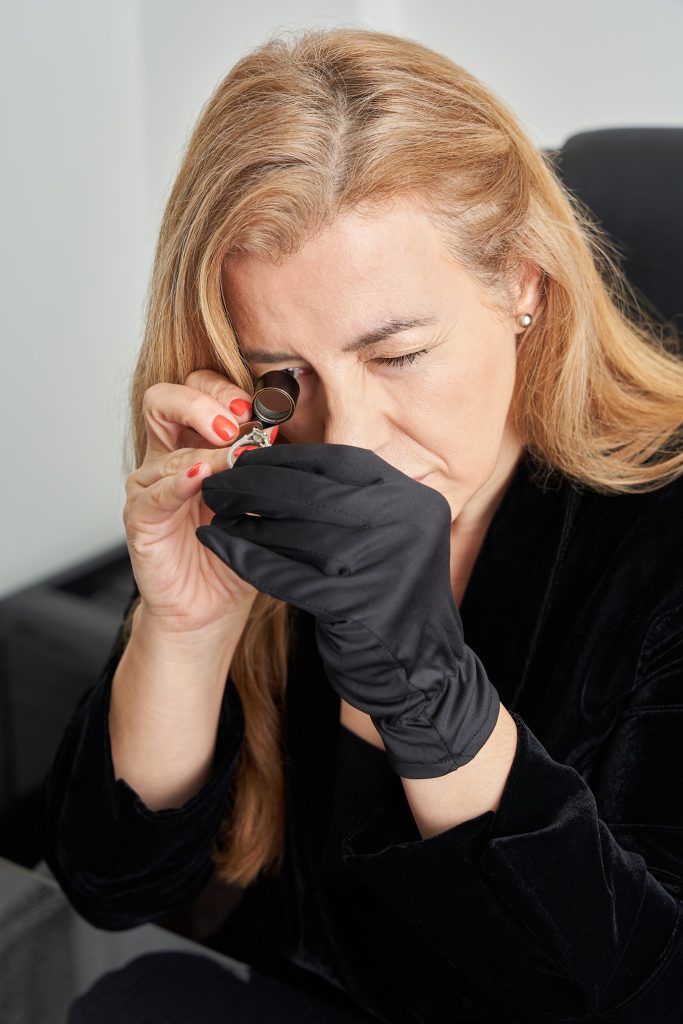
Using magnification and appropriate gemmological equipment, the specialist would examine the visible gemstone characteristics, settings, construction and identifying marks. Next, they would compare the ring’s configuration with its records.
Mounted settings can restrict inspection, so any assessments of weight and quality would need to acknowledge those limitations. Further testing could be requested where a finding is important to identification or value and cannot be established adequately during the initial examination.
The resulting assessment would bring together the ring’s identity, preservation, gemstone findings and market evidence to determine a final loan offer.
Illustrative collateral-loan assessment
If inspection and suitable market evidence support an assessment of £4,000, an illustrative loan-to-value ratio of 70% would produce a potential advance of £2,800.
That would meet the owner’s stated contribution towards the heating-system replacement.
The 70% figure is a scenario assumption. For this example, it assumes satisfactory identification, suitable condition and sufficiently persuasive evidence of resale value. No defect or missing component is presumed.
Of course, unexpected gemstone damage, setting wear, alterations, unresolved identification questions or less favourable comparable evidence could affect the amount offered. However, in this illustrative case, those factors do not apply.
Matching the agreement to the savings maturity
The owner would compare the bond’s confirmed maturity arrangements with the proposed loan deadline before deciding whether to proceed. A three-month term is requested for this scenario, subject to the terms available.
The application would require the relevant identification, proof of address and supporting documents. Pre-contract information and the proposed agreement would set out the advance, interest, charges, repayment date and redemption process.
Once an agreement is completed, the ring’s condition and any accompanying items accepted into storage would be documented. They would remain securely held until repayment under the agreement allows the owner to arrange their return.
Arranging an assessment of your Graff ring
For a Rosette ring, the quality of the assessment depends on identifying the particular jewel. Stone arrangement, gemstone findings, settings, documentation and appropriately matched sales all contribute to the lending decision.
An initial enquiry to New Bond Street Pawnbrokers can establish which photographs and records would be useful before an appointment at 5 Blenheim Street, Mayfair. Physical appraisal may identify a need for further examination before a final figure can be considered.
Any advance remains subject to assessment, acceptance and the agreement’s terms. Published auction results and preliminary valuations do not guarantee that a loan will be offered.

Featured in the Press
Our quality service, high standards, and innovative business practices have earned positive press coverage from a diverse set of media outlets such as The Times, The Telegraph, Time Out, Channel 4, The Spectator, and more.