

Cartier Diamond and Onyx Panthère Hoop Earrings – A Collateral Loan Case Study Example
The Cartier signature is a byword for class and elegance. However, for a luxury pawnbroker, appraising a pair of Panthère earrings requires deeper analysis. Some of the key steps involve establishing precisely which Panthère design is present, whether the earrings retain a consistent configuration, and how any repairs affect their condition and potential resale.
This hypothetical case study follows a pair of diamond-and-onyx Panthère hoop earrings whose owner declares a previous fastening repair. It describes the various steps, like authentication, diamond assessment, and establishing the impact and qualities of repairs when a customer wants to use Cartier Panthère earrings as collateral for a loan.


Scenario: Lease-extension fees before an expected annual bonus
In this illustrative scenario, a salaried professional needs £7,500 towards legal and professional fees associated with a lease-extension application. An annual employment bonus is expected in six months, but the fees are payable sooner.
The owner considers a seven-month loan against Cartier earrings received as an anniversary gift. They want to retain the pair rather than agree to a permanent sale.
The owner retains a Cartier box and purchase documentation. They describe light wear and explain that an independent jeweller repaired one earring’s fastening several years ago. The repair invoice is no longer available.
We request photos via email to offer the customer an initial indication, while making clear that any loan offer is contingent on a physical inspection.
Identifying the precise Panthère earrings
Cartier’s association with the panther began with a diamond-and-onyx spotted pattern on a wristwatch in 1914. When Jeanne Toussaint was appointed creative director in the 1930s, he helped develop the Panthère into one of Cartier’s most enduring motifs. Panthère remains part of Cartier’s current jewellery collections, but its designs vary considerably.
For this scenario, the assumed earrings are hoops set with brilliant-cut diamonds and onyx studs, signed Cartier. The dimensions, metal, diamond arrangement, onyx details and fastening construction would be recorded. This work would help us establish their production period.
Why the matching pair and onyx details matter
The appraisal would treat the earrings as a pair while examining each individually. We would compare the consistency of dimensions, stone arrangement, shape, and fastening construction.
The specialist would assess the diamonds for apparent colour and clarity differences, damage and signs of replacement. Mounted settings can restrict inspection, so precise grading or weight claims would need to reflect those limitations.
The onyx details would receive separate attention. Chips, surface damage, uneven fitting or an inconsistent replacement would be recorded rather than overlooked because the diamonds appear satisfactory.
The overall pattern also matters to identification. The specialist would consider whether the diamond and onyx arrangement is coherent with the stated Cartier design, alongside workmanship, marks and supporting records.
Condition, the repaired fastening and supporting documents
The declared repair would be a central appraisal issue. Our specialist would compare the repaired fastening with the other earring, checking for factors like alignment, engagement, movement and evidence of soldering or replaced components. They would consider whether the work appears confined to the fastening or extends into the surrounding structure.
A fastening that closes during a preliminary inspection would not, by itself, establish long-term security or originality. In the same way, an independent repair would not automatically make the earrings counterfeit or unsuitable. What truly matters is the nature and quality of the work itself.
Finally, we could welcome the purchase documentation because it helps support identification and ownership history. The Cartier box would be recorded as an accompanying item, and may increase appraised value because it gives the asset more completeness.
Researching comparable Cartier Panthère earrings prices
Bonhams records a pair of diamond-and-onyx Panthère hoop earrings selling for £17,750, including buyer’s premium. The lot was described as hoops set with brilliant-cut diamonds and onyx studs, signed Cartier. This could provide a completed-sale benchmark for the stated configuration.
The specialist would compare the owner’s pair with that example, checking dimensions, materials, stone arrangement, condition and accompanying items. The auction lot’s repair history would also need review before treating it as directly comparable.
The published figure is a premium-inclusive auction purchase price, not the seller’s net proceeds or an automatic valuation of the owner’s earrings. For the numerical illustration below, £15,000 is used as a provisional secondary-market assessment assumption.
Specialist assessment in Mayfair
The owner brings both earrings, the Cartier box and purchase documentation to our Mayfair premises.
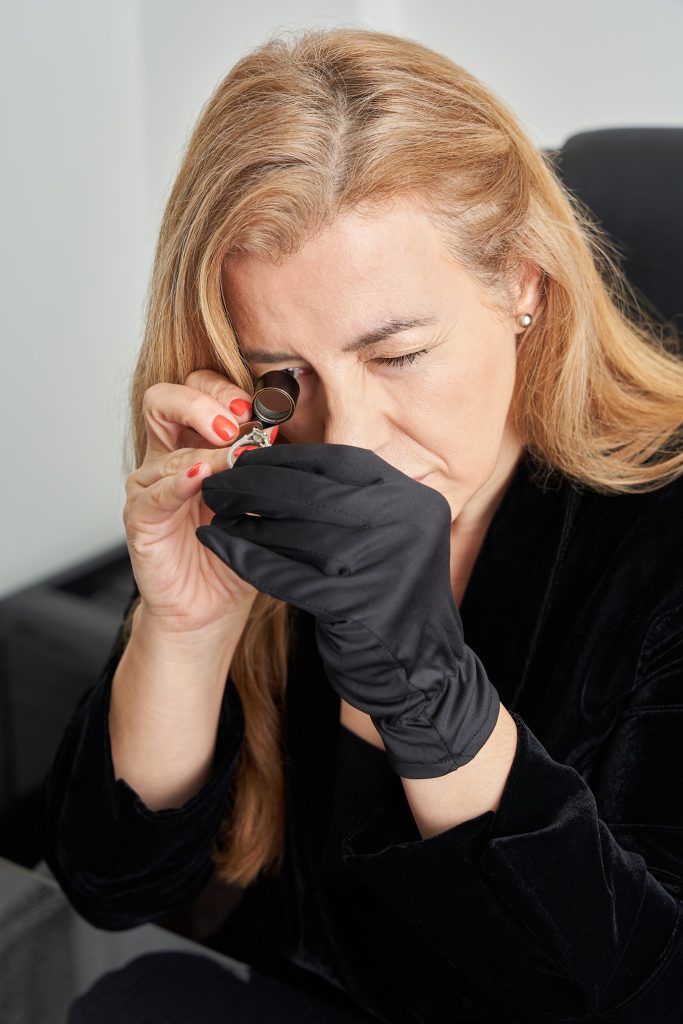
Our specialist would examine the stones, settings, hoop construction, fastenings and identifying marks using magnification and appropriate assessment equipment. The declared repair would be reviewed alongside the unrepaired earring, with any differences recorded.
The appraisal would address three core questions:
- Is the pair consistent with the stated Cartier design?
- Is its condition satisfactory for further consideration?
- What does comparable market evidence support?
Unresolved fastening security could require further technical examination and could affect the size of any loan.
Illustrative collateral-loan assessment
If physical inspection and current market evidence support an assessment of £15,000, an illustrative loan-to-value ratio of 50% would produce a potential advance of £7,500. That would meet the owner’s stated requirement.
The valuation would already need to reflect the pair’s condition and repair history. The 50% proportion represents additional lending caution in this scenario where the undocumented repair leaves uncertainty about originality or future saleability.
This is not a company policy that every repaired Cartier piece receives a 50% advance. Both the valuation and lending proportion are illustrative assumptions.
A seven-month agreement, secure storage and redemption
Before accepting any offer, the owner would review the proposed borrowing alongside the fees they need to pay. Photo identification, proof of address and any requested supporting documents would be required to progress the application.
The pre-contract information and agreement would explain the advance, interest, charges and collection arrangements. For this scenario, the requested term is seven months, although the period offered would depend on the available terms.
The owner expects their bonus in month six. Their repayment plan would need to cover the £7,500 advance plus the applicable borrowing costs, with another source of funds considered if the bonus is smaller than anticipated or arrives late.
Once an agreement is completed, we would record both earrings and any accompanying items accepted into storage. The pair would remain securely held until repayment under the agreed terms allows the owner to arrange collection.
Could your Cartier earrings support a specialist assessment?
Cartier’s feline motif makes the Panthère immediately recognisable. However, a pawnbroker’s assessment must go deeper. The precise configuration, consistency of the pair, diamond and onyx condition, fastening construction, repair history and supporting records all help determine which market examples are relevant.
To discuss whether your Cartier earrings could be suitable as collateral, contact New Bond Street Pawnbrokers. We can review the available details before arranging an in-person appraisal at 5 Blenheim Street, Mayfair.
Any potential loan remains conditional on assessment, acceptance and the agreed terms. A preliminary indication or valuation is not a commitment to lend.

Featured in the Press
Our quality service, high standards, and innovative business practices have earned positive press coverage from a diverse set of media outlets such as The Times, The Telegraph, Time Out, Channel 4, The Spectator, and more.