



Tiffany & Co. Schlumberger Sixteen Stone Gold and Platinum Ring – A Collateral Loan Case Study Example
The Tiffany & Co. Sixteen Stone eternity-style ring is visually striking and distinct. However, appraising this Jean Schlumberger-designed piece requires understanding the various versions of the ring, assessing its construction and condition, and finding comparable recent market data that relates to the precise configuration.
Assessing round brilliant diamonds is a big part of the process. While quality matters most, our experts would also check for things like damage and setting security, along with the condition of the ring’s continuous diamond-and-cross-stitch pattern.
This hypothetical case study follows an owner considering a four-month loan against a platinum example. It describes the steps involved in finding a fair and accurate secondary market value when a customer wants to use a Tiffany & Co. Sixteen Stone Ring as collateral for a loan.


Scenario: Replacing a professional instrument before booked performances
In this illustrative scenario, a self-employed musician needs £1,800 towards replacing a damaged instrument used for paid performances. They can cover the remainder of the purchase from savings but need the replacement before their next booking.
With several performances booked over the following three months, the musician considers a four-month loan, intending to repay from their fees.
They own a Tiffany & Co. Sixteen Stone diamond ring received as a family gift that they prefer not to lose. For this example, the ring is assumed to be the platinum-and-18K-yellow-gold version, approximately a Tiffany size 6. The owner retains its purchase documentation and presentation box, describes light wear and declares no repairs, resizing or replaced stones.
Identifying the precise Sixteen Stone ring
Jean Schlumberger conceived the Sixteen Stone design in 1959. The cross-stitch motif is a nod to his family’s roots in textile manufacturing. Since it was released, Tiffany has offered this fine jewellery design in several different configurations and prices.
The assumed asset is the full-size diamond version in platinum and 18K yellow gold. Tiffany’s current description gives approximately 1.14 carats of round brilliant diamonds for this configuration.
Our specialist would establish the ring’s dimensions, size, metal construction, stone arrangement and identifying marks. The purchase records would then be checked against those findings to ensure they match.
Why valuing the cross-stitch design takes expertise
First, the appraiser needs to understand how the gold X motifs relate to the platinum diamond settings and recognise differences between wear, repair and alteration. The specialist would compare the motifs around the band for consistency of shape, spacing and finish. Any uneven metalwork or an interruption in the pattern would require closer investigation.
The diamonds would be examined for apparent matching, damage and secure setting. A stone that looks different from its neighbours could warrant further assessment, but appearance alone would not establish replacement.
Mounted settings also limit what can be determined precisely. Diamond weights and grades would need to reflect those restrictions rather than be presented as equivalent to laboratory findings for loose stones.
Condition, ring size and supporting documents
The specialist would measure the ring and examine its circularity, interior, edges, gold motifs and diamond settings. Because the pattern continues around the band, any signs of resizing would need to be considered in relation to stone spacing and the integrity of the design. The owner declares no resizing, but physical inspection would need to support that statement.
Surface scratches would be recorded separately from distorted motifs, worn settings or evidence of soldering. The aim would be to establish the nature of the wear rather than to categorise the ring condition.
Tiffany and Schlumberger signatures, where present, and relevant metal marks would be reviewed alongside the workmanship. Finally, we would consider the purchase documentation as a factor that can support the configuration.
Researching comparable Tiffany Sixteen Stone ring prices
Bonhams records a platinum-and-18K-gold Sixteen Stone diamond ring selling for approximately £4,640, including buyer’s premium, in February 2024. This works as a rough completed-sale benchmark for the customer ring.
However, a 2022 Worthy auction could be a better configuration match. Its description records sixteen round diamonds with an estimated total weight of 1.06–1.18 carats, assessed G–H colour and VS1–VS2 clarity, and a ring size of 5.5. This watch sold for around £2,270.
The disparity in prices is not a trading range. We would check details like size, stone assessment, condition, and materials against both figures, and factor in that the Bonhams figure expressly includes buyer’s premium.
For this scenario, £3,000 is used as an illustrative secondary-market working assessment.
Specialist assessment in Mayfair
The owner brings the ring, purchase documentation and presentation box to our Mayfair premises.
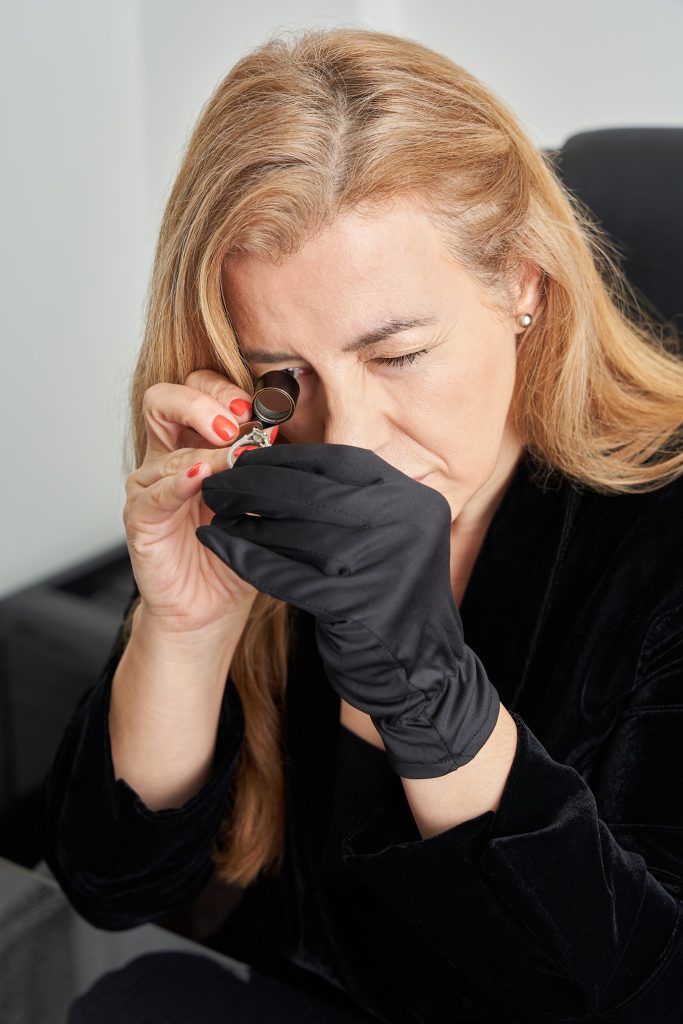
Our specialist examines the diamonds, gold X motifs, platinum settings, interior and marks using magnification and appropriate assessment equipment. We would also record the dimensions and ring size to ensure that they confirm with any information and documents presented.
Next, our expert would look for evidence of repair, replacement stones, or alterations. The specialist would then bring together identification, preservation, supporting records and the comparable-sale evidence. If everything was in order, we could commit to the £3,000 collateral loan price.
Illustrative collateral-loan assessment
If inspection and relevant market evidence support an assessment of £3,000, an illustrative lending proportion of 60% would produce a potential advance of £1,800. That would meet the musician’s stated contribution towards the replacement instrument.
The valuation and percentage are scenario assumptions, not a confirmed offer or fixed Tiffany lending policy. In this scenario, the loan-to-value ratio of 60% is based on the evidence that the ring is lightly worn. However, with some vintage rings, slight wear and tear is expected.
A four-month agreement, secure storage and redemption
Before committing, the musician would check whether the proposed loan fits both the instrument purchase and their performance schedule. A four-month term is requested for this example, subject to the terms offered.
The musician agrees to a four-month loan of £1,800. The application would require photo identification and proof of address. Before signing, the owner would receive pre-contract information in plain language and an agreement detailing the advance, interest, charges, repayment deadline and how the ring could be reclaimed.
Following completion of an agreement, the ring and any accompanying items accepted into storage would be documented and securely held. The owner could arrange their return once repayment is made in accordance with the agreed terms.
Could your Tiffany Sixteen Stone ring support a specialist assessment?
A Sixteen Stone appraisal combines knowledge of Schlumberger’s construction with assessment of the particular ring’s metal configuration, diamonds, settings, size and preservation. Completed auction sales can inform the process, but their relevance depends on how closely they match the asset presented.
For an initial discussion about using your Tiffany ring as collateral, speak to New Bond Street Pawnbrokers. We can review the information you provide and arrange a specialist appraisal at 5 Blenheim Street, Mayfair.
An appraisal or indicative figure does not guarantee a loan offer. Any lending remains subject to assessment, acceptance and the terms of the agreement.

Featured in the Press
Our quality service, high standards, and innovative business practices have earned positive press coverage from a diverse set of media outlets such as The Times, The Telegraph, Time Out, Channel 4, The Spectator, and more.