

A. Lange & Söhne Lange 1 101.021 – A Collateral Loan Case Study Example
Two Lange 1 watches can look remarkably similar while actually belonging to different mechanical generations. The original L901.0 movement and the later L121.1 seem alike at first glance, but their architecture and date-change mechanisms differ. Identifying and understanding the generation is an essential part of selecting appropriate comparables.
This hypothetical case study follows the assessment of a yellow-gold Lange 1 reference 101.021. It explains how the movement, dial configuration, date operation, case condition, buckle, service records and current market evidence all need to come together when a customer tries to use an A. Lange & Söhne Lange 1 watch for a collateral loan at a luxury pawnbroker.


Scenario: A home repair before a savings account matures
In this scenario, a retired architect needs £10,000 towards urgent roof repairs after water enters their home. The contractor requires an initial payment before work begins, while a notice savings account is due to release funds in eight weeks.
The owner considers a three-month loan against a Lange 1 rather than selling a watch purchased to mark their retirement. The former architect confirms that the funds will arrive within that allotted time, which means that covering the loan for three months is possible.
For this example, the owner presents a yellow-gold 101.021 with its box, original guarantee documentation and a manufacturer-service invoice. The leather strap is a later replacement, but the owner retains the signed yellow-gold prong buckle.
At first contact, we would request photographs of the dial, case, date corrector, crown, movement, buckle and documents. These could support an initial indication, but a final assessment would require physical inspection at our Mayfair office.
Establishing the precise Lange 1 reference
The assumed watch is a Lange 1 reference 101.021 with a 38.5 mm, 18-carat yellow-gold case, champagne-toned dial and sapphire caseback. It uses the manually wound L901.0 movement and combines an off-centre time display, subsidiary seconds, outsize date and power-reserve indicator.
The exact reference matters because case metal, dial configuration, size, complications and movement generation can affect both price and buyer preference. A platinum 101.025, yellow-gold 101.022, Grand Lange 1, Moon Phase or later-generation Lange 1 would therefore be considered separately rather than used as a direct benchmark for this 101.021.
The specialist would consider the case and movement identifiers, dial configuration and supporting records together to get a rough estimate that would not function as a final offer.
Checking the outsize date and power-reserve display
The Lange 1’s outsize date uses two separate display elements to show the date through adjacent apertures. Its operation deserves specific attention rather than being treated as an ordinary date window.
Our specialist would examine the alignment and presentation of the numerals, then assess the date-setting and changeover functions using the appropriate procedure for the movement. Hesitation, incomplete advancement or inconsistent operation would require further investigation because they could imply needed service that would change the appraised value of the timepiece.
The generation distinction is particularly important here. The first-generation L901.0 does not have the later L121.1’s precisely instantaneous midnight date change. A gradual changeover would therefore not automatically be treated as a fault simply because a newer Lange 1 behaves differently.
The winding action and AUF/AB power-reserve display would also be checked. The model’s specified 72-hour reserve describes its intended performance. However, it is not a measured result for this particular watch. An initial inspection could not establish that the watch currently achieves the full reserve.
Movement finishing, case preservation and service history
The L901.0 features a three-quarter plate made from untreated German silver, along with traditional decorative finishing and a hand-engraved balance cock. Those details form part of the movement’s identity and appearance, but they do not establish its present mechanical condition.
Through the sapphire caseback, the specialist would examine the visible movement for consistency and signs requiring closer review. The warm tone associated with German silver would not automatically be mistaken for damage; its appearance would instead be considered alongside any staining, corrosion or evidence of intervention.
We would then review the yellow-gold case for dents, scratches, softened lug profiles and excessive refinishing. We would also inspect the crown, date corrector, caseback markings and buckle for condition and consistency.
In this scenario, the later leather strap would be recorded separately from the retained gold buckle. The manufacturer lists an 18-carat yellow-gold prong buckle for this reference, so confirming the supplied buckle would be more informative than simply describing the watch as being “on leather.”
Finally, we would read the service invoice for any work it documents. In particular, we would look out for any replacement components or refinishing work that may have occurred over the years.
Researching comparable Lange 1 prices
The market research would focus on yellow-gold 101.021 examples with comparable dial configuration, case preservation, buckle, documentation and service history. Different metals, complications, generations and exceptional editions would be considered separately.
Recent auction results of £13,059 at Dr Crott and £16,546 at Dannenberg in 2026, alongside £14,845 at Dorotheum and £15,214 at Loupе This in late 2025, would need to be considered. A £28,449 Antiquorum result in May 2026 illustrates the variation between individual lots. Condition, accessories, buyer’s premium and currency conversion would need evaluation before direct comparison.
Some dealer advertisements include examples around £17,500–£23,900, with some higher. These are asking prices, not completed sales, and would be considered separately from auction results. Additionally, while this watch is recovering in recent years, it is still some way down from its 2019-22 peak, which is a customer expectation we may need to manage.
For this scenario, £15,000–£19,000 could serve as a more cautious illustrative secondary-market working range, subject to inspection and closely matched sales. The retained gold buckle, supporting documents and manufacturer-service invoice would inform the assessment, but would not automatically justify a premium over the auction evidence.
Specialist assessment in Mayfair
The owner brings the Lange 1, box, guarantee documentation and service invoice to our Mayfair premises.
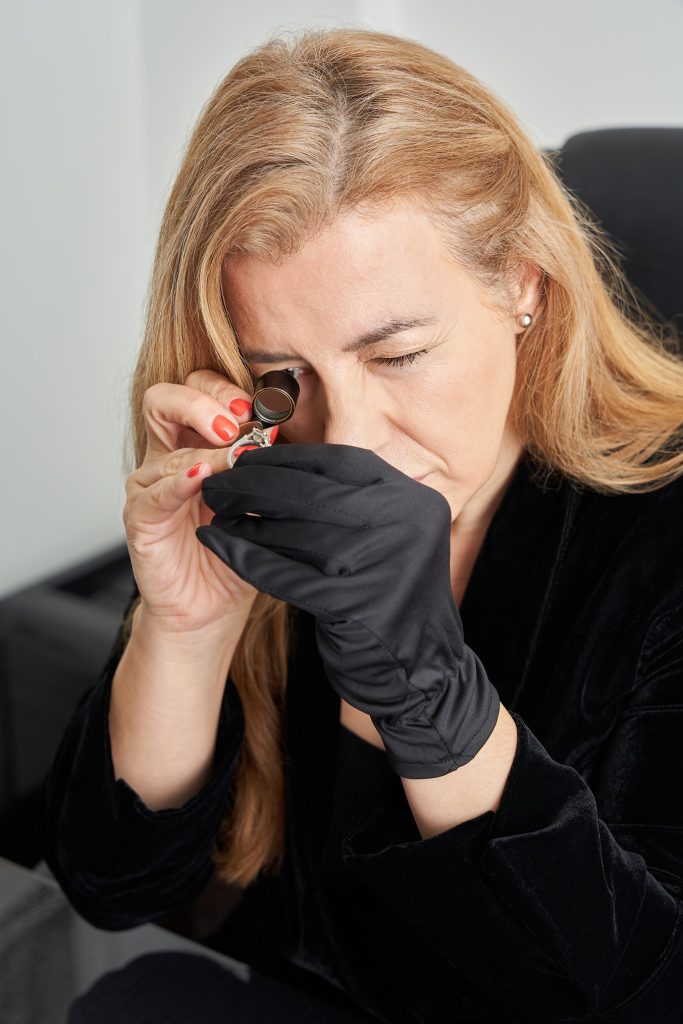
Using appropriate handling equipment and magnification, our specialist would review the dial, hands, date apertures, case, lugs, crown, date corrector, crystal, buckle and visible movement. The winding, setting, date and power-reserve functions would be assessed without presuming satisfactory operation.
The appraisal would bring together three main areas:
- Consistency with reference 101.021 and its L901.0 movement.
- Case preservation, dial condition, buckle and documented service work.
- Current evidence for similarly configured and preserved examples.
Any unexplained mechanical behaviour or component inconsistency could require further technical review before the watch is considered suitable as collateral. A photograph-led indication would remain only a starting point.
Illustrative collateral-loan assessment
If inspection and recent, appropriately matched comparables support a secondary-market assessment of £15,000–£19,000, an illustrative lending proportion of 60% would produce a potential advance of £9,000–£11,400.
Both the valuation and lending proportion are scenario assumptions, not a confirmed offer or fixed lending policy. The assessment would reflect current evidence rather than stronger historic auction results.
The owner’s £10,000 repair requirement falls within that illustrated range but would not be covered at its lower end. Unresolved date-mechanism issues, significant case refinishing, an incorrect buckle or weaker comparable evidence could reduce the amount available.
The later leather strap would already form part of the appraisal assumptions. Any additional replacements disclosed by the service records would also be considered, rather than describing the watch as entirely original.
Agreement, secure storage and redemption
If the owner wishes to accept a suitable offer, they would provide the required identification and supporting documents. We would then issue the pre-contract information and proposed loan agreement for review, detailing the amount borrowed, applicable charges, loan term and arrangements for redeeming the watch.
The intended three-month period allows some time beyond the expected eight-week savings release. It does not guarantee that the funds become available as anticipated. The owner would need to confirm the withdrawal arrangements and consider repayment if access is delayed.
Once an agreement is in place, the Lange 1 and its agreed accompanying materials would remain in secure storage as collateral. The owner could redeem and collect the watch after repaying the loan and applicable charges in accordance with the agreed terms.
Could your A. Lange & Söhne support a specialist assessment?
A Lange 1 requires a reference-specific appraisal, not a valuation based solely on the A. Lange & Söhne name. The movement generation, outsize-date operation, power-reserve function, dial, gold case, buckle, service history and relevant market evidence all inform the assessment.
Contact New Bond Street Pawnbrokers for an initial indication of your watch’s potential collateral value and to arrange a specialist assessment at 5 Blenheim Street, Mayfair.
Any loan remains subject to assessment, acceptance and the agreed terms. An initial indication or valuation does not guarantee a loan offer.
Featured in the Press
Our quality service, high standards, and innovative business practices have earned positive press coverage from a diverse set of media outlets such as The Times, The Telegraph, Time Out, Channel 4, The Spectator, and more.