

Luxury jewellery from a house like Cartier is more than mere decoration; it is also a portable, globally recognised piece of capital that can be unlocked in hours at the right pawnbroker. Like other high‑end brands, Cartier’s blend of heritage design, precious materials, and non-stop demand gives many of its rings, bracelets, necklaces, and earrings strong loan‑to‑value potential.
From evergreen Love and Trinity pieces to daring Panthère creations and high‑jewellery showstoppers, there is a broad spectrum of Cartier designs that can support everything from modest short‑term loans to substantial six‑figure funding, provided condition, completeness, and provenance are in order.

This article highlights 10 types of Cartier jewellery pieces to pawn.
Love Bracelet (Classic Bangle)
The Cartier Love bracelet is one of the most recognisable jewellery designs in the world. Created in 1969 by Aldo Cipullo as a unisex “modern handcuff” that screws onto the wrist to symbolise enduring commitment, it’s a great choice when you need to access a loan on Cartier jewellery.
Its tight oval shape, visible screw motifs and minimalist silhouette give it an instantly identifiable look that has become a staple on celebrity and collector wrists alike, ensuring deep, global demand. That steady demand translates directly into strong collateral value, with pre‑owned classic plain Love bangles in 18ct gold typically listed around £4,500–£6,500 in the UK. Additionally, half‑diamond versions are often in the £8,000–£9,000 bracket and full‑diamond models climbing into the low‑ to mid‑£10,000s depending on size and condition.
For luxury pawn shops, this combination of iconic status, clear price bands, and a very liquid secondary market makes the Love bracelet an excellent Cartier asset to lend against, especially when accompanied by box and papers.
Trinity Ring (Classic Three-Band)
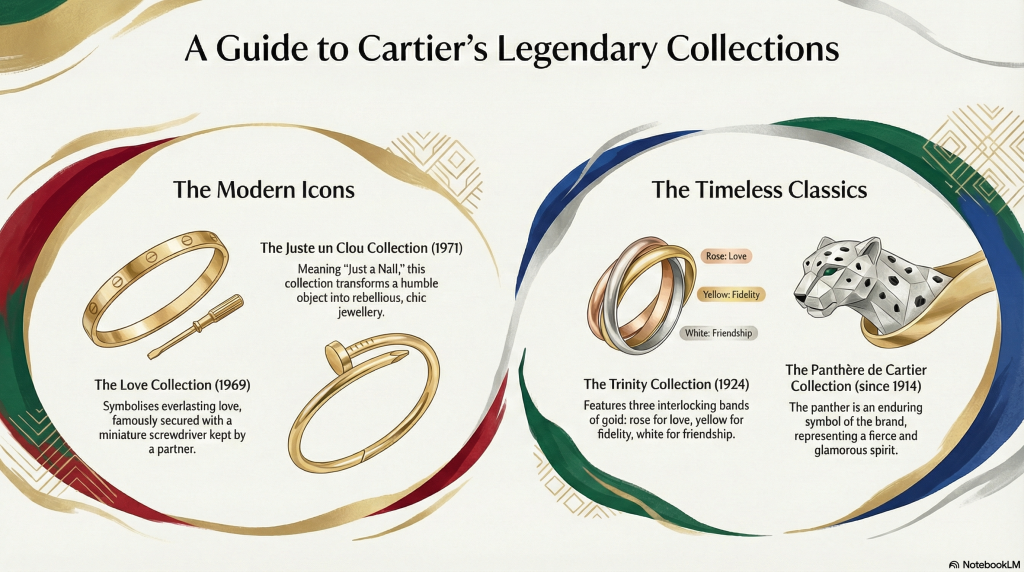
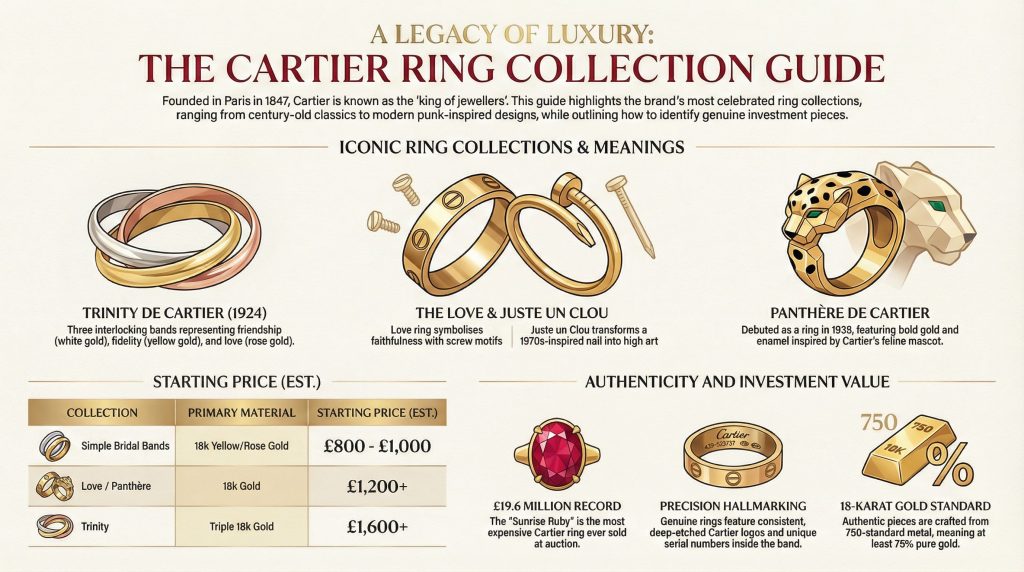
The Trinity ring is one of Cartier’s most enduring designs. Created in 1924 by Louis Cartier as three interlocking bands that glide over one another on the finger, each band in yellow, white and rose gold symbolises love, fidelity and friendship, giving the piece a rare emotional resonance that keeps it in constant demand across generations.
That history and symbolism, combined with its discreet, everyday wearability, make the classic three-band Trinity a reliable asset to pawn. One driving factor that makes this Cartier ring pawnable is that it’s instantly recognisable to both retail buyers and professional jewellers, yet less flashy than diamond-heavy pieces, so it appeals to a broad audience.
On the UK secondary market, plain medium-model Trinity rings in three golds often list around £1,000–£1,500, while diamond-set or vintage high-jewellery variants can range roughly from £4,000 to the £7,000+ bracket depending on size, stones and condition. To get strong value, work with a Cartier pawnbroker like New Bond Street Pawnbrokers for a free valuation.
Juste un Clou Bracelet
The Juste un Clou bracelet reimagines an ordinary nail as a sleek, wrapped bangle. Originally created in 1971 by Aldo Cipullo in New York, it’s now seen as a symbol of rebellious, minimalist luxury. Its clean, androgynous lines and sculptural silhouette make it a favourite stacking piece for fashion‑forward clients, yet it remains instantly linked with the French brand, which is good news when you’re trying to raise collateral from a Cartier piece.
That mix of strong branding and contemporary edge underpins its resale strength. Recent reports show Cartier bracelets can retain around 90–95% of their value on the secondary market, with Juste un Clou among the top performers.
In the UK pre‑owned market, slim 18ct gold Juste un Clou bangles frequently list around £2,500–£3,500, while full‑size classic versions often sit roughly in the £5,000–£6,000 range, with pavé diamond models climbing higher depending on condition, size and completeness of box and papers.
Juste un Clou Ring
The Juste un Clou ring miniaturises Cartier’s nail motif into a sculptural band that wraps around the finger, offering the same rebellious, industrial chic as the bracelet but in a more accessible format. Its clean, modern profile works as an unisex everyday piece, yet the design is instantly recognisable, which is exactly what pawnbrokers look for when assessing how quickly they can resell a ring.
Because this beloved ring sits at a lower price point than the bracelet while still carrying strong brand equity, it is a practical choice for clients who want to unlock three‑ or low four‑figure sums without parting with a major showpiece.
On the UK secondary market, plain 18ct gold Juste un Clou rings typically list roughly around £900–£1,400, while diamond‑set or thicker wrap versions can run from about £1,800 up toward £3,500+, depending on metal, stones, size and condition.
Love Ring (Band)
The Love ring translates Aldo Cipullo’s 1969 screw‑motif design into a sleek band that can be worn every day, ensuring it remains one of Cartier’s most pawnable pieces. Its flat profile, engraved “screws” and choice of yellow, white or rose gold create a modern, unisex look that pairs easily with other jewellery while still signalling the same idea of “locked‑in” commitment as the bracelet.
For pawnbrokers, this combination of symbolism, strong branding and broad appeal is attractive, even though rings typically retain slightly less than bracelets. Market data suggests Cartier rings still hold a healthy share of their value, with Love wedding bands among the best‑performing.
On the UK secondary market, plain 18ct Love bands commonly list around £700–£1,200, while multi‑gem or pavé‑diamond versions often range from roughly £2,000 up to £3,500+, depending on metal, stones, size, condition and completeness
Love Interlocking Necklace
The Love Interlocking necklace distils Cartier’s iconic screw‑motif design into a softer, more subtle form by suspending two or more intertwined Love rings or round pendants from a fine chain.
The design keeps the collection’s “bonded together” symbolism, but in a lighter, more versatile format that works for everyday wear and layers neatly with other necklaces. For pawnbrokers, this piece is appealing because it sits in the hugely recognisable Love family while often coming in at a more approachable ticket than the full bangle, making it easier to place with a wide range of buyers.
In the UK secondary market, plain 18ct gold Love‑style interlocking necklaces typically change hands in the region of roughly low four figures, with many listings clustering around the £1,200–£2,000 mark and diamond‑set or multi‑motif versions reaching higher, depending on metal, stone count, condition and whether original box and papers are included.
Panthère de Cartier Ring
The Panthère de Cartier ring is one of the house’s most characterful designs, turning the brand’s panther emblem into a stunning three‑dimensional feline head that wraps around the finger in gold, enamel, onyx and vivid gemstone eyes.
Originating from Jeanne Toussaint’s panther creations of the mid‑20th century, it carries powerful associations with strength, sensuality and high style, which gives the ring strong storytelling value at resale.
For luxury pawnbrokers, that combination of sculptural design, heavy precious‑metal content, and instantly recognisable DNA makes Panthère rings prime Cartier collateral, especially as the wider Panthère line is known to hold high resale percentages compared with other jewellery collections.
UK and European secondary‑market listings show a wide price band depending on stones and metal, with simpler gold Panthère rings often advertised in the mid‑£4,000s equivalent, and diamond‑set white‑gold or high‑jewellery versions ranging roughly from around £7,000 up to well over £20,000 for the most elaborate pieces. In other words, if you bring the right piece for valuation at a Cartier pawnbroker, you can access a healthy loan.
Panthère de Cartier Bracelet (Panther Bangle)
The Panthère de Cartier bracelet takes Cartier’s panther motif and turns it into a sculptural bangle, often with one or two panther heads meeting around the wrist in gold, lacquer, onyx, diamonds and vivid emerald or tsavorite eyes. It is one of the clearest expressions of Cartier’s high‑jewellery identity: bold, three‑dimensional and instantly recognisable as a statement piece, which gives it strong desirability among serious collectors that translates into significant loans against your Cartier jewellery.
From a pawnbroking perspective, this combination of artistic design, substantial precious‑metal weight and frequent pavé diamond work makes the Panther bangle blue‑chip collateral, particularly as notable Panthère jewels have a strong track record at auction and in the secondary market. Depending on metal, scale and stone setting, pre‑owned Panthère bangles can range from high four‑figure sums into the tens of thousands of pounds, with fully diamond‑set or vintage high‑jewellery examples capable of reaching well into the six‑figure bracket, which supports substantial, high‑end Cartier loans, especially when condition and provenance are strong.
Tutti Frutti Bracelet
The Tutti Frutti bracelet is one of Cartier’s most celebrated high‑jewellery styles. The bracelet is characterised by carved emeralds, rubies and sapphires mixed with diamonds in an exuberant, asymmetrical design inspired by Indian Mughal jewellery. It stands out because each bracelet is effectively a miniature, hand‑assembled art piece, with irregular shapes and colours of the stones giving every example a slightly different character.
For luxury pawnbrokers, a genuine Cartier Tutti Frutti bracelet sits at the very top end of collateral. These adored bracelets combine museum‑level design pedigree, significant gemstone value and strong demand at major auctions, where similar pieces have reached six‑ and even seven‑figure sums in prime condition.
However, because values vary widely by age, provenance, stone quality and whether the bracelet is a historic or modern creation, any serious loan would be based on a specialist high‑jewellery appraisal, at a Cartier pawn shop like NBSP.
Trinity Diamond Drop Earrings
The Trinity Diamond Drop earrings take Cartier’s classic three‑band Trinity motif and extend it into an elegant, elongated drop, usually in intertwined yellow, white and rose gold set with brilliant‑cut diamonds. This gives the wearer the emotional symbolism of the Trinity design (love, fidelity, friendship) and the extra sparkle and presence of a dress earring.
From a pawnbroking angle, they are attractive because they combine recognisable branding, tri‑colour gold weight and meaningful diamond content, which supports solid loan values and relatively swift resale.
On the UK and European secondary market, Trinity diamond earrings and drops typically list from around the mid‑£3,000s into the £6,000–£8,000 region, with larger carat weights or vintage high‑jewellery examples sometimes advertised considerably higher, depending on stones, metal, condition and paperwork.